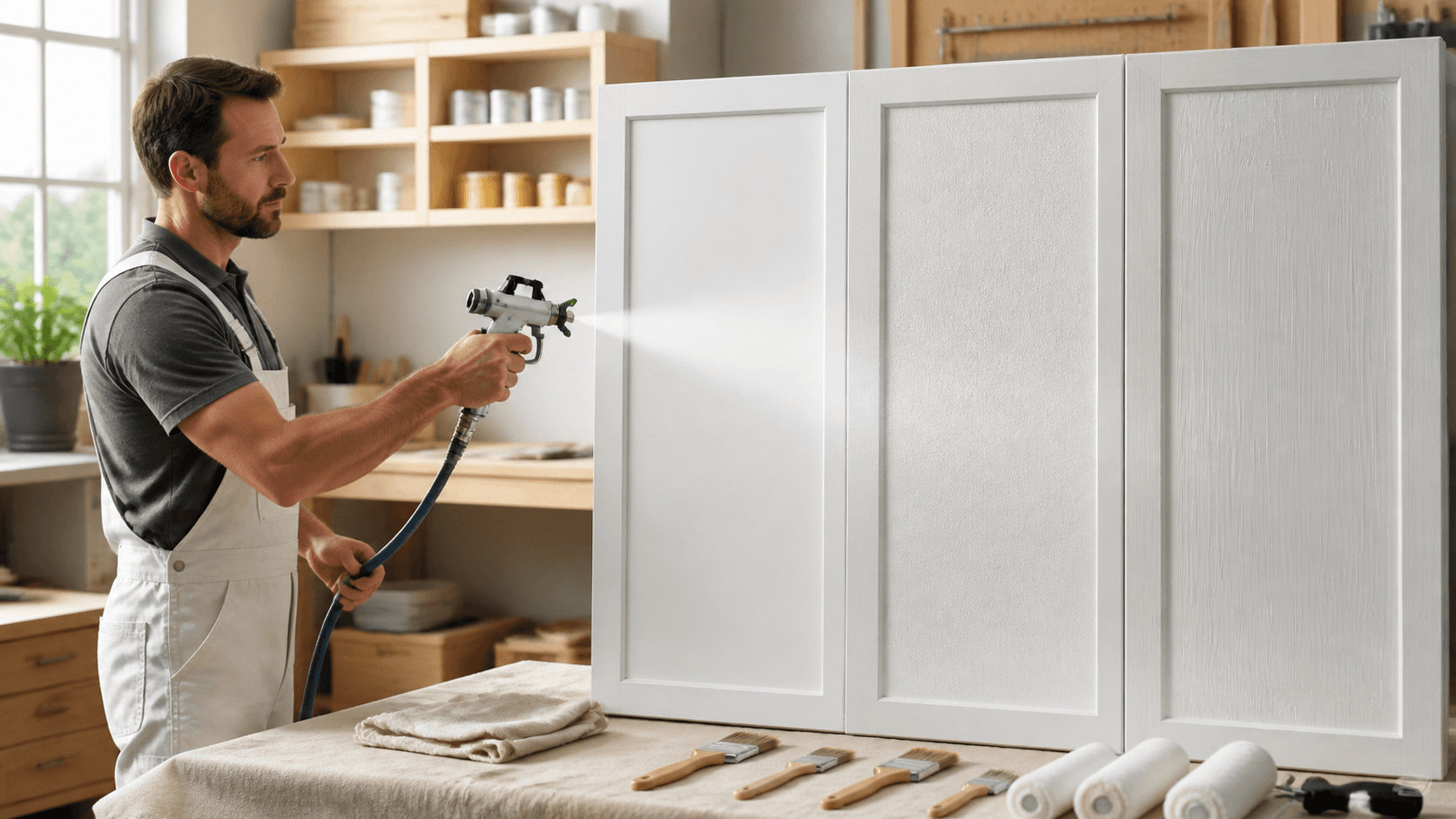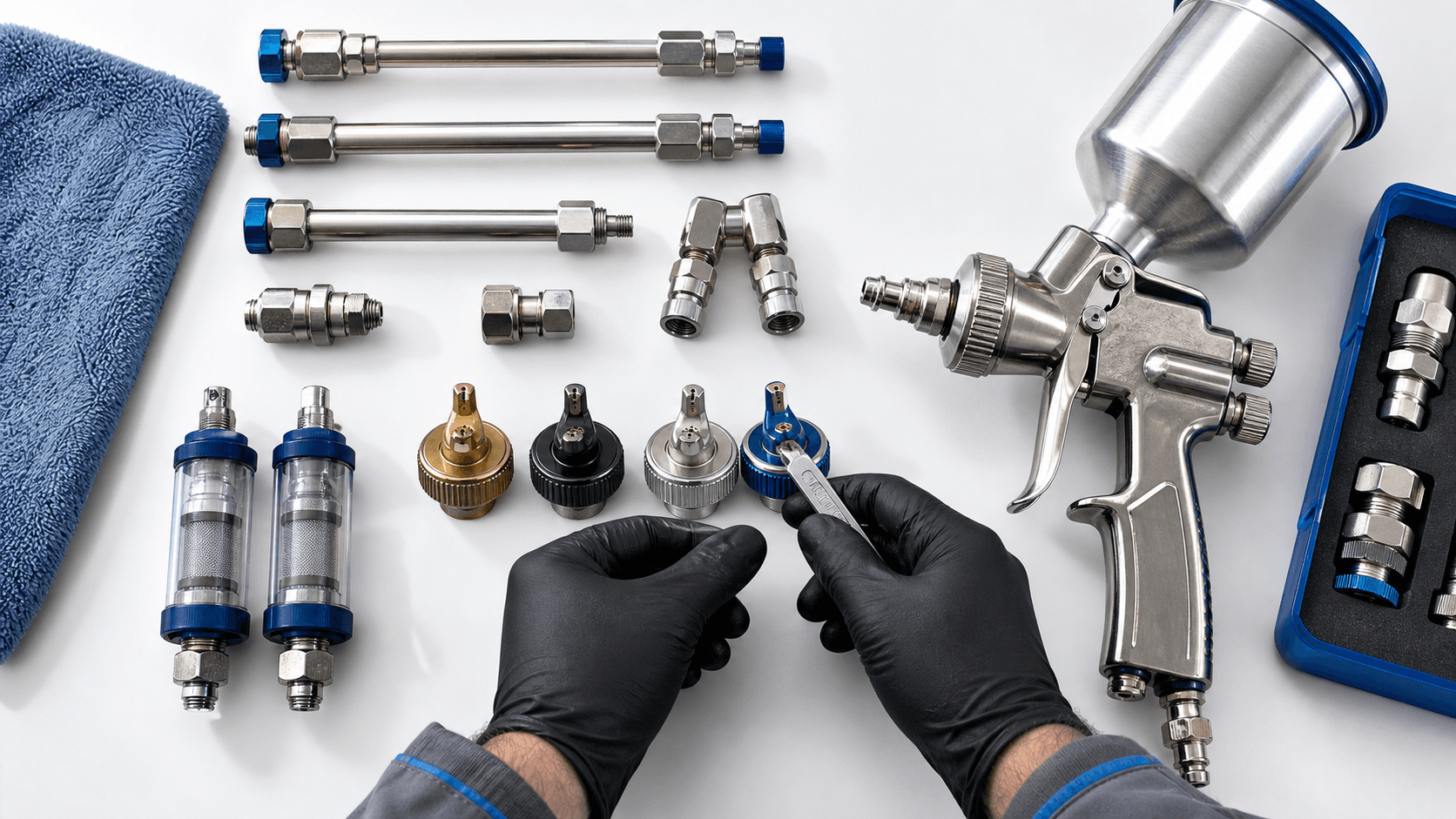
Stop Brushing Complex Details and Start Spraying Smarter
Complex architectural details like stairs, railings, cabinets, and vaulted ceilings are where good paint jobs slow to a crawl. Brushes and small rollers can leave lap marks, runs, and thin spots, especially on tight corners and turned parts. On top of that, all the bending, reaching, and ladder work wears you out fast.
When we match the right paint sprayer accessories to each tricky area, the whole job changes. We get cleaner coverage, more consistent film build, and better control in tight spaces, with less strain on our shoulders and back. That is why building a simple accessory selection matrix is so helpful. We can look at the area we are spraying, then quickly pick the right extension, swivel joint, tip size, and filters for that task.
Core Paint Sprayer Accessories That Change the Game
For most stairs, cabinets, and vaulted rooms, four accessory groups matter most:
- Extensions
- Swivel joints and angle adapters
- Spray tips
- Filters
Gun guards and hoses also matter, but these four parts are what really shape how the paint goes on the surface. Each one plays a different role.
- Extensions change how close we can work while still standing safely.
- Swivels and angle adapters help keep the fan pattern square to the surface.
- Tip sizes and patterns control how much paint we lay down and how wide the fan is.
- Filters keep trash out of the tip so we do not get spitting or sudden plugs.
As early fall rolls in and outdoor work starts to slow here in Ohio and across much of the country, indoor projects ramp up. Many crews turn to interior repaints, stair and railing refinishing, cabinet updates before holiday gatherings, and touch-ups in great rooms. That is when the right paint sprayer accessories really pay off in speed and quality.
Extensions and Swivels for Stairs, Railings, and High Ceilings
Extensions are not just for reaching high ceilings. Used the right way, they also keep us in a safer stance on stairs and give better angles on railings.
Short extensions, around 10 to 20 inches, shine when we need close control:
- Railings and balusters
- Cabinet faces and doors on racks
- The underside of handrails and stair stringers
That extra 10 to 20 inches lets us stand back just enough to see the fan pattern and keep a smooth pass, without jamming the gun into corners.
Medium extensions, roughly 24 to 40 inches, are handy for:
- Stairwell walls
- Standard-height great room ceilings
- Two-story foyers where we still want some fine control
Long extensions, 48 inches and up, are for true high-reach work like vaulted ceilings and upper walls that would otherwise mean constant ladder moves.
We do have to think about weight and balance. An extension that is too long for the task can:
- Cause arm fatigue fast
- Make the fan arc at the end of the stroke
- Pull the gun out of square, which leads to uneven coverage
That is why pairing longer extensions with light spray guns and a swivel joint is smart. A swivel at the end lets us turn the gun head to the right angle while letting our wrist stay relaxed. On stairs, that can be the difference between a smooth, level pass and a shaky one from an awkward reach.
Tip Sizes and Filters for Railings, Cabinets, and Detail Work
Fine details need smaller tips and cleaner paint flow. Wide wall tips dump too much material on narrow parts and lead to runs, curtains, and drips.
For broad interior walls with standard latex, many painters use tips in the 415 to 517 range. That gives:
- A wider fan pattern for faster coverage
- Enough material to build a solid film in fewer passes
On rails, spindles, and cabinet doors, we usually want smaller patterns in the 210 to 312 range. These tips give us:
- Narrower fans that fit narrow parts
- More control around edges, trim, and inside profiles
The coating type matters too. Typical latex on stairs and railings often pairs well with:
- Tips: 210 to 312 for rails and spindles, 413 to 415 for stair walls nearby
- Filters: Finer gun filters matched to smaller tips to cut down on spitting
For enamel or urethane cabinet finishes, we want smooth, even laydown with very little trash:
- Tips: 208 to 310 for doors and drawer fronts
- Filters: Fine mesh in both gun and manifold to match the small-orifice tip
For heavier, high-build products on beams or accent details:
- Tips: 313 to 415, depending on how wide the member is
- Filters: Slightly more open mesh that still protects from plugs, but allows thick material to flow
When our filters match our tip choice and coating thickness, we see fewer tails on the fan, fewer sudden plugs, and a much smoother finish on small, detailed parts.
Seasonal Accessory Matrix for Fall Interior Projects
As work shifts inside in early fall, it helps to think in scenarios. Here are simple starting points for common interior jobs.
If you are spraying stained or painted railings:
- Extension: 10 to 20 inches for close control
- Swivel: Gun swivel or small angle adapter for underside of rails
- Tip: 210 to 312 range for rails and balusters
- Filter: Fine mesh gun filter matched to the small tip
If you are repainting kitchen cabinets:
- Extension: Short 10 to 20 inch or no extension for tight work around boxes
- Swivel: Adjustable angle adapter to reach cabinet interiors and underside of uppers
- Tip: 208 to 310, adjusted to door size and coating
- Filter: Fine mesh gun and manifold filters for smooth enamel or urethane flow
If you are tackling a vaulted living room or great room:
- Extension: 24 to 40 inches for most ceiling work, 48 inches or more for very high vaults
- Swivel: Adjustable angle adapter at 45, 60, or 90 degrees for steep vault planes and beam sides
- Tip: 415 to 517 for broad ceiling fields, slightly smaller if working around beams
- Filter: Medium mesh filters that match your wall and ceiling latex
Planning these pairings before the season starts pays off. When we build an accessory kit for our common interior jobs, we cut changeover time between rooms and keep our setups consistent from project to project.
Put Your Accessory Matrix to Work
The next step is to build your own go-to matrix. Take your most-used coatings, latex for walls and rails, your favorite cabinet finish, and the stain or clear coat you use on beams, and list them alongside the architectural details you see most often. For each combo, pick a standard extension, swivel or angle adapter, tip size range, and filter mesh. Keep that list on the trailer, in the shop, or in a simple digital note.
Over time, crews can standardize on these setups, train new team members on when to switch accessories, and track which pairings give the fastest, cleanest results. At Integrity Supply here in Ohio, we talk with contractors and serious DIY users across the U.S. who are doing exactly that: tightening up their accessory choices so they can spray smarter, move safer, and deliver better finishes on every set of stairs, railings, cabinets, and vaulted ceilings they touch.
Get Started With Your Project Today
Equip your team with reliable paint sprayer accessories so every job runs smoother and finishes faster. At Integrity Supply, we select products that help you work efficiently while maintaining professional results. If you have questions about choosing the right accessories for your sprayer or project, contact us and we will help you find what fits your needs.
John Colavecchio is the President and CEO of Integrity Supply, an Ohio-based supplier of painting, safety, hardware, tools, and construction-related products. With Integrity Supply founded in 2000 and serving contractors, painters, and trade professionals for more than two decades, John brings practical industry knowledge to articles covering paint supplies, spray equipment, job-site tools, and professional product selection. His content is written to help contractors and serious DIY customers choose the right products, avoid common project mistakes, and get better results from trusted industry brands.